Our Programs…
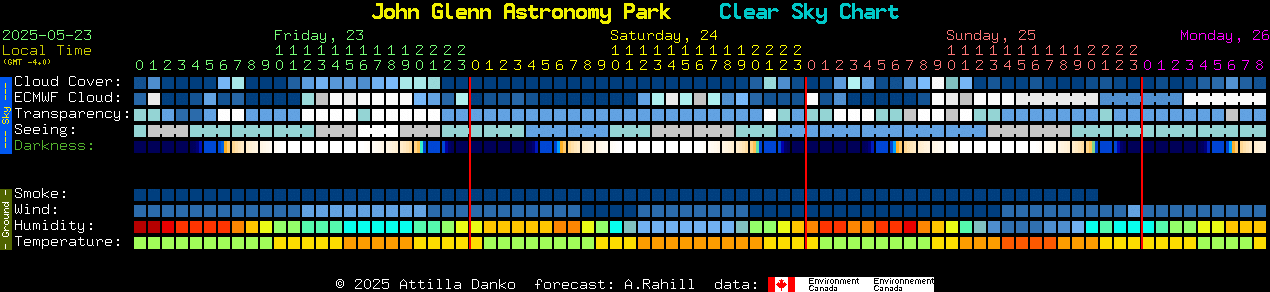
… are on clear Friday and Saturday nights from March - Late November. Watch the main page. By noon on the day of each program we post a forecast and a note on whether or not the program that evening will go forward.
Get your free parking passes at this website.
May 15-16: Exploring Hubble’s Legacy This weekend is the birthday of Nancy Grace Roman, the “mother of the Hubble Space Telescope”. Under dark skies, we’ll be exploring some of the more famous targets if this venerable satellite. The views won’t look like the images that Hubble captured, but the photons of light will have come directly from the objects. 8:45 PM EDT
May 22-23: Jupiter and Venus in the West With Jupiter setting in the west, this week is a good time to get a last look at it before it is lost in the evening twilight. On May 22, Jupiter will have two solar eclipses going on at the same time in its cloud-tops, just as the world dips into the trees. 8:45 PM EDT
May 29-30: The Bright Moon The nearly full moon lights up our plaza. Come learn how moonlight, far from being silvery blue, is bright enough to reveal the true colors of the world. 8:45 PM EDT
June 5-6: Jupiter, Venus and Gemini A striking “appulse” (close approach) of Venus and Jupiter against the stars of Gemini draw the eye. Come learn about these two worlds and about the forgotten Gemini program, which taught astronauts and engineers the skills to get humans to the moon. 8:45 PM EDT
June 12-13: Hercules the Hero and Boötes the Hunter These two constellations are high overhead, and in dark skies, this weekend. Come learn the stories associated with them and explore a few, dramatic star clusters within 8:45 PM EDT
June 19-20: Spring turns into Summer The programs this weekend occur on the last two days of spring. The sun will be setting in alignment with the summer solstice window in our plaza. Come learn how other cultures watched the sun and tracked its comings and goings. Then we’ll look at the crescent moon. 8:45 PM EDT
June 26-27: The Low Moon. The titled orbit of the moon sometimes takes it high in the sky, and sometimes makes it skirt the southern horizon. This weekend, the moon hovers over the trees in the south. Also, brilliant Venus is in the West. 9:00 PM
July 3-4: How Far Are the Galaxies? This weekend is the birthday of Henrietta Swann Leavitt, the person who figured out how to determine the incredible distance to the galaxies. If the weather is clear, we can look at a few galaxies through our big scope. 9:00 PM
July 10-11: The Long Twilight At this time of year, it does not get fully dark until quite late. Once the skies are dark, however, the Milky Way arches high overhead. Also, Venus shines in the West. 9:00 PM
July 17-18: Happy Birthday John Glenn. Come find out about our namesake, John Glenn, Ohio Senator and the first American to orbit the Earth. Also: Venus in the west and a thin Crescent moon. 9:00 PM
July 24-25: Voyage to the Moon. This weekend we’ll explore the sites of the Apollo missions as well as the location of possible future human exploration of the moon through our telescopes. 8:45 PM
July 31-August 1: Our Sister Planet. Venus is almost the same size as Earth, and it is the world that comes closest to us. But our “sister” world has a bad personality. Also, the beautiful star cluster, M13. 8:45 PM
August 7-8: The Perseid Preview. The Perseid meteor shower peaks on Wednesday, but those who stay up late will be able to see a preview of it in the week beforehand. Come learn about meteor showers. Also, the Milky Way arches high overhead. 8:45 PM
August 14-15: Celestial Clouds. The Milky-Way is filled with clouds of gas and dust between the stars- the nebulae. These clouds are where new stars are born and are the remnants of their dramatic deaths. 8:30 PM
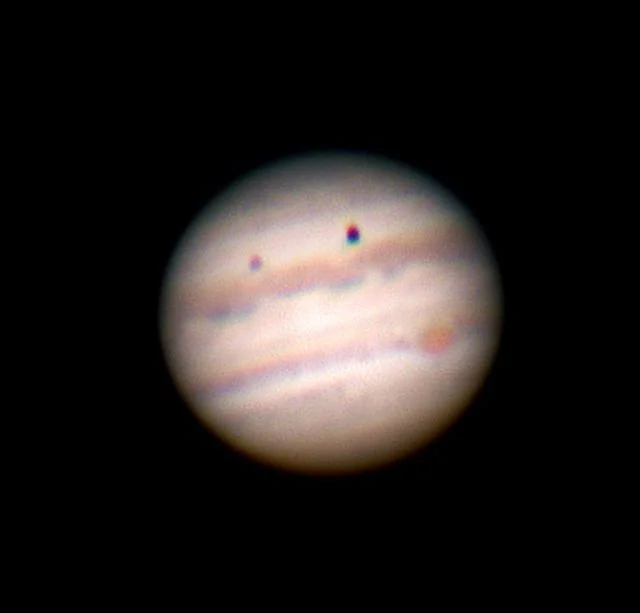
Jupiter and shadow transit by Andy Downey
View of the Month:
Jupiter
The most common astronomical question I’m getting right now (February 2026) is “what is that bright star high in the east?”
If it’s early evening, and it’s still late winter or early spring of 2026, the answer is almost certainly “Jupiter.”
The largest planet in our solar system, Jupiter could fit over 1320 Earths inside its volume (if you crushed the rocks down and filled in all the spaces). However, Jupiter is not made of rock (at least not much rock). It is, instead, nearly all hydrogen, helium, and an assortment of other gasses.
In other words, Jupiter is all clouds.
And it is the brown grey, orange and red-ish colors of those clouds that we see when we look through an amateur telescope at high power.
Each band of clouds represents a region where the winds are going more or less the same direction and speed around the planet. The light color bands tend to go one way (relative to the bulk of the planet) and the dark bands go the other.
At the intersection of those two winds, gigantic eddies form. But the word “eddies” sells them short. These “tiny” oval blobs are, in fact, continent sized hurricanes whipped up by the difference in wind speed between the two adjacent regimes. The grandest of these eddies, is the giant, cannabalistic, Great Red Spot, a bit larger than the Earth.
The Great Red Spot (GRS to its friends) can often be made out as a pale, deep orange, blob when the correct side of Jupiter is facing us. If the GRS is not in view, you don’t have to wait too long for it to appear again. A “day” on Jupiter is just under 10 hours. If you can’t see it, you don’t have to wait much longer than 5 hours for it to come back around again. (By which time Jupiter may have set, alas)
Deep in the heart of Jupiter, beneath many thousands of miles of compressed liquid, metallic hydrogen (the pressure is so great, it turns the gas into a dense liquid), there may be a residue material left over from the planet’s formation which could plausibly be called “rock” if it were not for the fact that it glows at temperatures hotter than the surface of the sun.